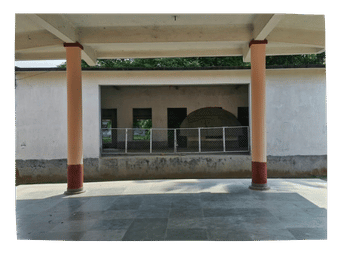
Timeline of our work
More than two and a half decades have passed since the Basu family of North Kamarpole formed Sree Sreedhar Jeeu Trust in 2000. In this time, we have done much of what we set out to do. Our traditional pujas and festivals are held smoothly. When we formed the Trust, our old temples and structures were badly ruined. We have now restored most of them. We have faced many ups and downs along the way, and we have carried on our work through them. This was possible because of the honest effort, sacrifice and resolve of a group of keen and far-sighted people from our family. It was also possible because every member of our family gave us their support.
Before the Trust Was Formed
The Trust did not appear suddenly. Our family worked steadily to look after our old temples, our structures and our traditional pujas. The decision to form a Trust came out of this long effort. The work had begun at least fifteen years before the Trust was formed.
Around 1984, the “Basu Para Puja O Unnyan Committee” was formed. Its aim was to run the yearly Durga Puja and to repair our old temples and structures. Members of the Basu family of North Kamarpole set it up together.
Everything was in a broken state at that time:
- The two Shiva temples were falling apart.
- The two library rooms were damp, dusty tin houses.
- The atchala was shaky.
- The Durga temple and Narayan Ghar were old and worn. The plaster was peeling and the floors were full of holes.
- The Saner Pukur behind the Shiva temple had eroded. The bank had crumbled almost up to the temple grounds.
So we took up the responsibility to repair and started with a gentle effort.
Our first job was to build up the bank of Saner Pukur. We decided this in 1984. The president of the committee was The late Prabhat Kumar Sen, and we held our meetings at his house. Other committee members at the time were The late Nishikanta Basu, The late Ashok Kumar Basu, The late Swapan Basu, Samar Kumar Basu, Raghunath Basu, Aniruddha Basu and Dinabandhu Basu. The patrons of the committee included The late Sadhan Kumar Basu, The late Satyendranath Basu, The late Nirmal Basu, The late Sarbaribhushan Basu, The late Anil Basu, The late Subir Kumar Basu, The late Bhabani Shankar Basu, and others.
The work needed money, but we had no funds. The late Sadhan Kumar Basu was then in charge of Saner Pukur. We made a six-year contract for the pond with him and received a lump sum. All the shareholders of Saner Pukur also gave us their six years’ share as a donation. With help from all our family members, we repaired half of the bank. A brick guard wall was built and earth was filled in.
The late Manoj Purkait made a special contribution here. He supplied the building materials. Sometimes we ran short of money, but he never stopped the supply. The mason Mohiuddin Molla also played an important role.
After the work on the Saner Pukur bank moved ahead, we decided to repair the atchala, the Durga temple and the two library rooms. These buildings were in such poor condition that small repairs were needed almost every year just to keep them standing. Our family members paid for this work.
When the committee ran the yearly Durga Puja, the cost was met from the income of some land. This land was next to the North Kamarpole Free Primary School. We leased out the land and used the money for Durga Puja and the other pujas. As a result, there was a money shortage every year. Family members had to pay extra donations to cover the gap.
So on 25 December 1993, we jointly decided to sell the land. It took several years to carry out the decision. The land was finally sold in 1996. We deposited the money in a bank as a fixed deposit.
These years were a time of intense activity. We decided to set up a Trust as a lasting institution, so that the money from the land sale would never be lost. We took steps to register the Trust. The late Abani Mohan Sinha helped with this. He was a former judge of the Calcutta High Court and a relative of the late Ashok Kumar Basu. The trust deed was prepared and registered in 2000 under his guidance. Forty-nine sebayats (family members who serve the deity) of the Basu family signed the trust deed. A board of nine trustees was formed from among them.
At the same time, we started repairing the twin Shiva temples, which had fallen into ruin from lack of care.
We decided to repair the two Shiva temples in 1997. Many casuarina trees stood on the temple ground. Mukul Basu and Bidyut Deb had planted them. We sold these trees and used the money to start the work. Maimur Molla, a contractor and mason from the Nurpur area, was given charge of the repair. He completed the work with great care.
The money from the trees was not enough, and a large amount was still needed. Family members covered the shortfall. The late Sujit Basu, Timir Basu, Rama Baidya, the late Swapan Basu and the late Rathindranath Basu made special contributions. Their generous help allowed us to finish the temple work on time.
After the Journey of the Trust Begins
We had built a fund from the sale of the land. When we formed the Trust, we adopted a clear financial policy to protect it. Salient features of that policy was - (1) The entire sale money would stay in the Trust’s bank account as a permanent deposit. (2) The interest from it would pay for the pujas and festivals. (3) Any surplus would go to charity, service work and repair of structures. (4) If a repair needed extra money, our family members would pay it through donations. (5) The principal deposit would never be spent. Finally, This policy became a rule of our Trust.
Since 2000, we have carried on our work for more than two and a half decades. Our financial policy has not changed. We have done the pujas, festivals and repair work from the interest on the deposit and the donations of our family members. Because of this, it was often not possible to complete a repair all at once. Many projects had to be finished in stages.
In this period, we restored The temple of Sree Sreedhar Thakur (Narayan Ghar), The Durga temple, The Naivedya room (offering room), The atchala, The library, The flower garden, Bel Tala, Buro Shiv Tala, The Jora Shiv Mandir ground. We also built a cultural stage and a garage. Only the repair of Panchanan Tala is still pending. But we never touched our principal deposit for any of this work. In fact, the deposit has grown over the last two and a half decades.
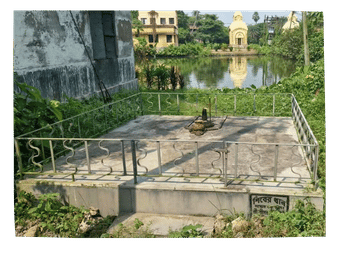
After registration, we took up the repair of Buro Shiv Tala. The shrine (Buro Shiv Than) stands under an old banyan tree near the house of the late Anil Basu, a member of our family. In earlier days, the Shiva Gajan, Jhanp and other pujas were held here. In 2000, the ground around the shrine was built completely. Samar Kumar Basu played an important part in this work. The mason was Rashid Mondal.
The Kamarpole Reading Club was set up in 1921 in Basu Para. At that time it was the only library in Diamond Harbour subdivision. It played a big role in reading and cultural life in the area. Later, it was closed for lack of care, and its rooms fell into ruin. In 2001, we decided to repair the two library buildings.
The family of the late Surendra Basu offered to turn one building into a charitable health centre named after Dr. Surendranath Basu. We agreed. His family members repaired the building and set up the health centre.
We repaired the other building ourselves and built a permanent house. All members of our family gave money for this work. Debapriya Ghosh, Jayanta Palit, Sarbani Dutta, Rama Baidya, Timir Basu, Susanta Basu and the late Sujit Basu made special contributions.
In 2002, the Kamarpole Panchayat built the main road of the village. The Kadamtala pond was dredged for this. The pond bank had broken down completely. A good part of the temple ground had slipped into the pond. We got the land back and built a brick guard wall. Fresh earth was filled in to protect the temple ground.
In 2002, we began work on Narayan Ghar and the Durga temple. The inside of Sree Sreedhar Thakur’s temple had to be redone almost completely. The floor was broken up and new steps were built. A new stone floor was laid. Samar Kumar Basu, Dinabandhu Basu and the late Swapan Basu played an important part in this work.
The inside of the Durga temple and the Naivedya room was in bad shape. The walls were damp and salt-damaged, the floor was full of holes, and the rooms were wet. We rebuilt all the walls and floors inside. At that time, only a cement floor could be made.
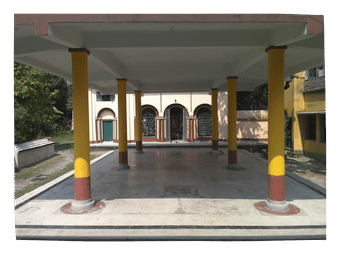
The atchala was in a shaky state. It had weak wooden posts and a tin roof. There was always a fear that it would collapse in a storm. In 2004, we decided to repair it. A qualified engineer was needed to get the structure right for a permanent atchala. Biswajit Basu and Rupen Mitra took up this task. We built the new atchala following their technical plans and advice.
After the atchala was repaired, we needed space to store the old tin sheets and wooden posts. We built a godown next to the Durga temple. Later, we turned it into a car garage.
In the same year, we began work on the flower garden, at the urging of the late Sujit Basu. The garden wall was in ruins, and we rebuilt it. A path was laid inside for upkeep, and many flowering plants were planted. However, we could not keep up the care of the garden over the years. In recent times, some of our family members including Nimai Chand Basu, Soham Sen, Arka Basu, Soumya Basu have taken up its care with enthusiasm.
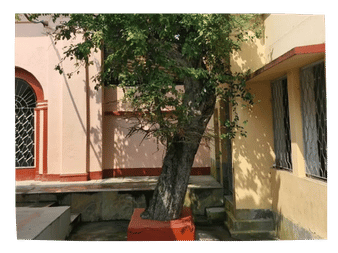
An old bel tree stands beside the atchala. The tree and the ground around it are known as Beltala. On Shashthi of Durga Puja, the Kala Bou puja is held here. But Beltala had a mud floor, which caused real trouble during the puja. If it rained on Durga Puja days, the place could not be used. So we decided to protect the old tree and repair the ground below it. A new cement floor was laid.
In the same year, we built a permanent cultural stage in front of the atchala. This is where the old Deuri (gateway) once stood. Today, our family members gather on this stage for cultural programmes during Durga Puja, Rabindra Jayanti and other occasions.
In 1984, only half of the Saner Pukur bank could be built up with brick. The other half kept crumbling and was eating into the land behind the Shiva temples. So in 2009, we built a brick guard wall on the remaining half.
The idols of our family’s Durga Puja are immersed in Saner Pukur. The bank had been repaired, but the ghat and the platform were in very poor condition. So in 2011, the bathing ghat was renovated and the platform in front was newly cast in concrete.
Waterlogging in the rainy season was a big problem on the temple ground. The Kadamtala pond had no drainage. In the monsoon, its water often overflowed onto the temple ground. The ground stayed muddy and the bank was damaged. To fix this, we built a high drain connecting the Kadamtala pond to Saner Pukur. This stopped the soil erosion and the waterlogging.
The utensils and other items needed for Durga Puja used to be kept at the house of the late Satendranath Basu followed by the late Swapan Basu. Later, we decided to make a permanent place for them. We repaired the Naivedya room and made a permanent storage space inside it for the puja utensils.
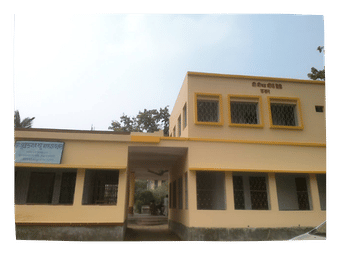
In 2015, we built a new floor on top of the library building. During Durga Puja, it serves as a resting room for the visiting priests. For the rest of the year, it is our Trust’s office. We named the building Sree Sreedhar Jeeu Trust Bhavan, after our family deity. It was formally inaugurated on 17 October 2015. In the same year we could manage to get dedicated bank locker to keep the ornaments of our deity.
When the inside of the Durga temple was repaired in 2002, only a cement floor could be made. In 2017, we decided to lay a stone floor. The work was finished in 2018. The floor inside the Durga temple and in the Durga Dalan is now stone. In this work the late Prabir Basu, Anita Sarkar, Rama Baidya, Sanchita Basu, Susmita Basu Mukherjee, Swapna Dutta, Rita Bhattacharya, Sonali Basu made special contributions.
After the first repair in 2000, we began the second stage of work at Buro Shiv Tala in 2021. Stone was laid on the shrine, and a grill was put around it. Shiva puja is held here today in the months of Baisakh and Shravan. On Shivaratri and Neel Shashthi, women of the Basu family and the village also worship Shiva here. At the same time, stone was laid on the floor inside the Jora Shiv Mandir. All this work was finished in 2022.
After Buro Shiv Tala and the Jora Shiv Mandir, we began work on the atchala floor. To make the floor strong, it was first cast in concrete. A full stone floor was then laid. The work was completed in 2023. The late Manju Basu, wife of the late Bhawani Sankar Basu, had set aside some savings in her lifetime. She wished that this money be donated to Sree Sreedhar Jeeu Trust after her death. Following her wish, her daughters Shantana Palit and Supriya Ghose made this donation after her passing. We used this contribution for the atchala floor renovation. We remember her generosity with gratitude.
Annual Audit
Work We Have Accomplished
When we formed the Trust, our old temples and structures were in ruins. Over the last 25 years, we have restored most of them, step by step. Some of those works are listed below.
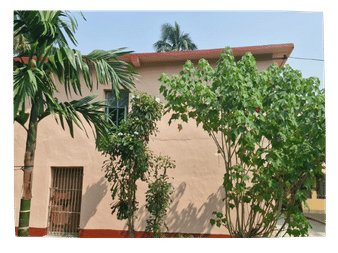
Narayan Ghar
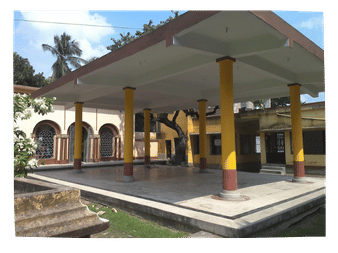
Durga Mandir
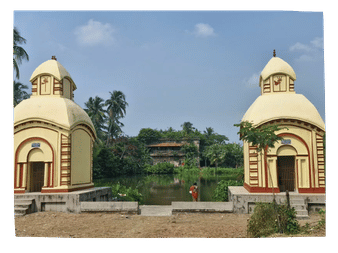
Shiva Mandir
Buro Shiva Than
Atchala
Sreedhar Bhawan
Bel Tala